The Reconnection Session
Medically reviewed by Ashlee Gendron, PT, DPT, PCES. Content prepared with acupuncturist Nina Jung, L.Ac.
When a patient walks in with a hypertonic pelvic floor, I look at their jaw before I look at anything else. It's clenched almost every time. That pattern is what led me to build this co-treatment with acupuncturist Nina Jung, L.Ac. We recommend it as a series of three 60-minute sessions where both of us work on you at the same time, in the same room, coordinated in real time. Single sessions are also available if you want to try one before committing to the full series.
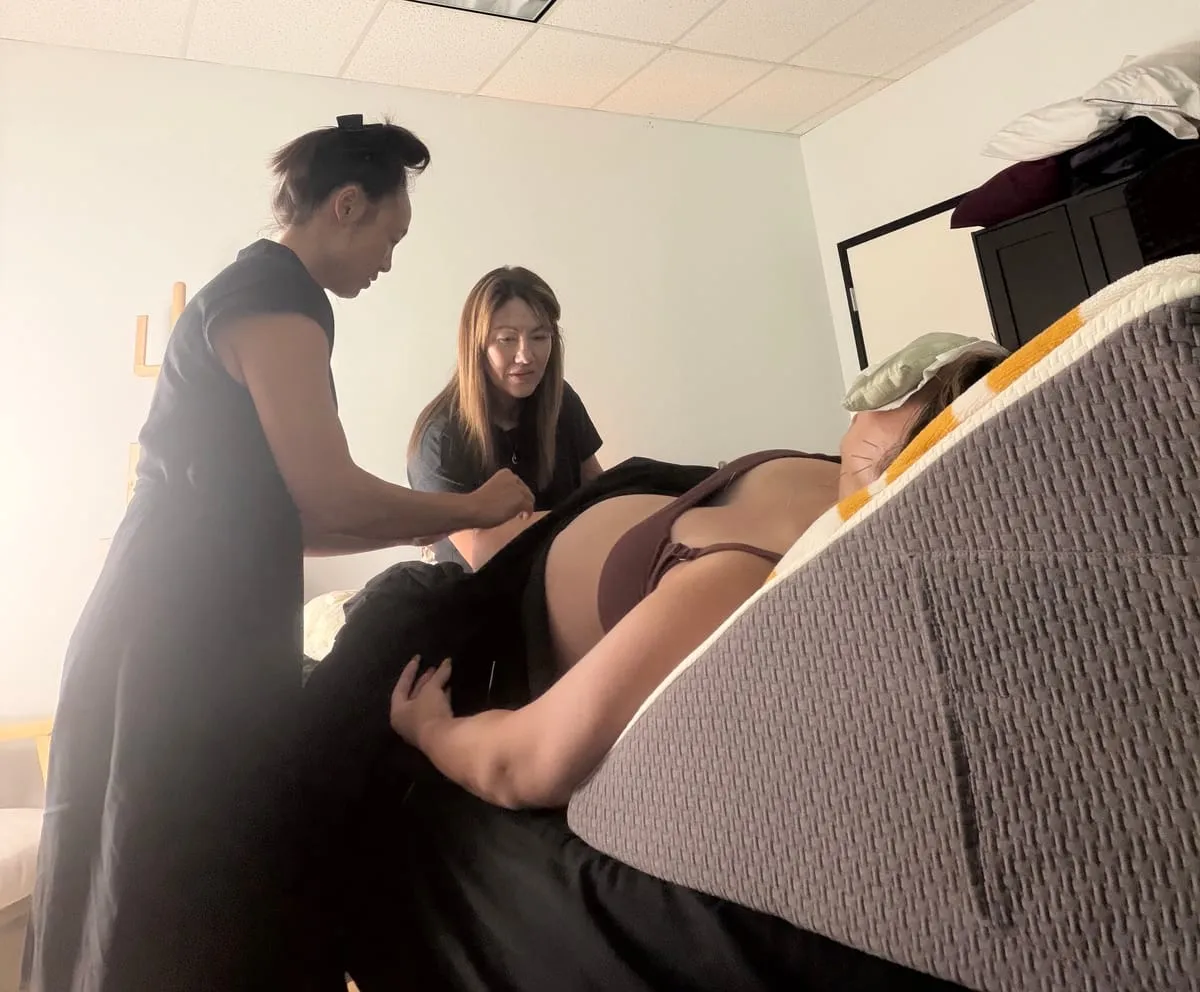
Most of what I treat is nervous system as much as it is tissue. The pelvic floor is dominated by the autonomic system, and a patient who lives in fight-or-flight will not hold onto a manual release, no matter how good the technique. That pattern shows up in chronic pelvic pain, hypertonic pelvic floor, painful intercourse, and about half of what I see in my regular practice. Manual release plus a nervous system that's still braced equals a temporary result.
Nina Jung is a licensed acupuncturist I had known clinically for a while before we started co-treating. The first time we ran a session together, I saw something I hadn't seen in single-modality PT. As Nina worked the jaw and calmed the autonomic system, the internal tissue I was holding responded faster than my usual timing. And the release stayed. That's what this session is designed around.
To my knowledge we are the only two providers in San Diego offering this as a single, coordinated appointment. Most other combined care requires two separate visits on two separate days. We do it together, in one room, at the same time.
Why jaw and pelvic floor together?
The jaw and the pelvic floor are the two most consistent tension carriers in the body. Both are anchored to a shared fascial chain that runs the length of the trunk (Bordoni & Zanier, 2013), and both are directly regulated by the autonomic nervous system. Chronic stress patterns tend to lodge in one or both.
Clinically, once I started running this pattern, it stopped feeling like a coincidence. A patient with chronic neck tension almost always has a tight pelvic floor. A jaw clencher almost always has one too. Working just one end of that chain rarely resets the underlying pattern for good. Working both ends simultaneously often does.
On the acupuncture side, needling at the jaw and along fascial lines that connect to the pelvic outlet shifts activity in brain regions involved in autonomic regulation (Chae et al., 2013). From there, the internal manual work I do actually lands and holds. That is the mechanism this session is built around. For more on the jaw-pelvic floor connection, see this blog post.
What happens in a session?
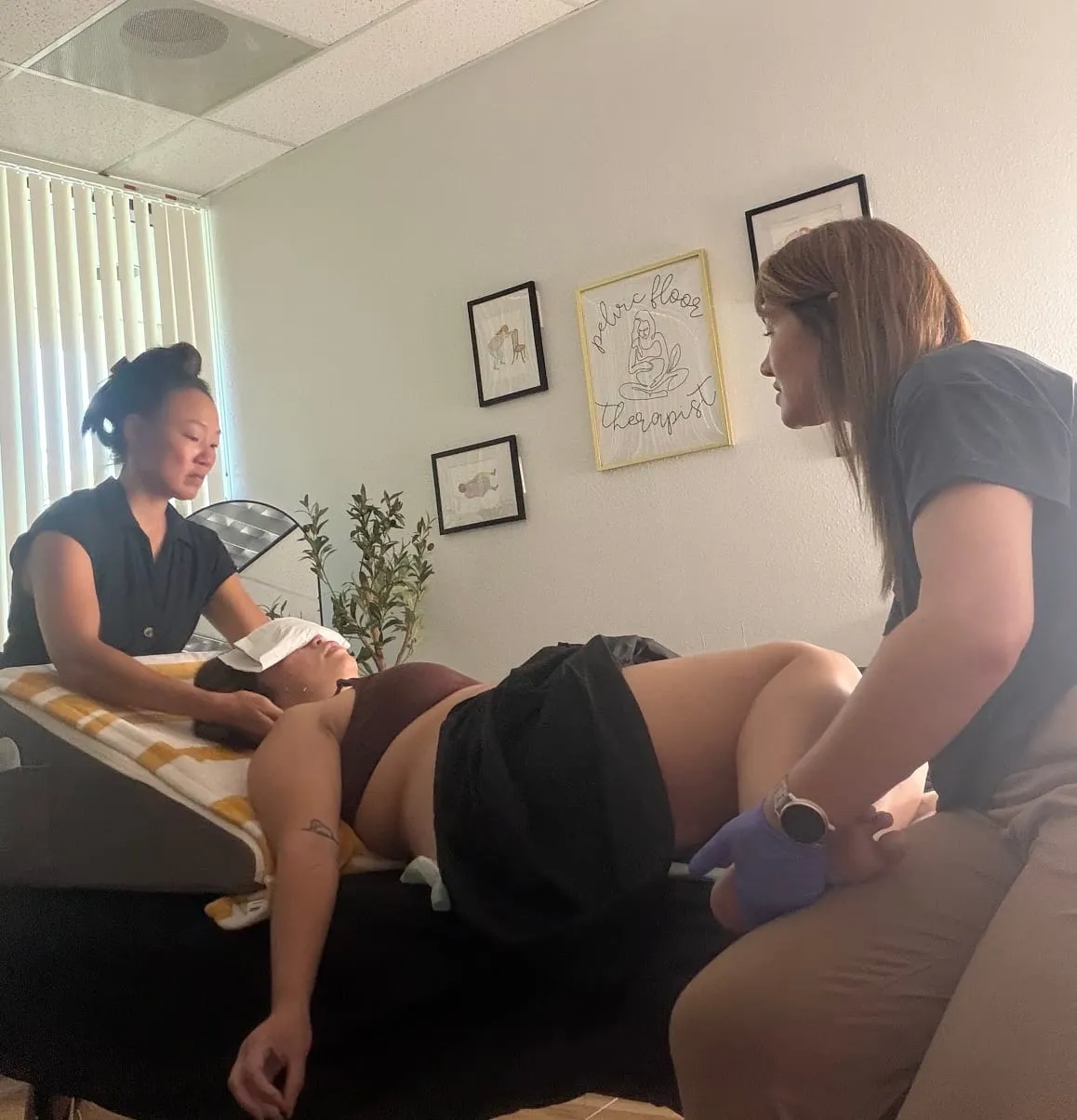
Two providers, one appointment. Here is what a typical session looks like from my side of the table. Specific modalities vary across the three-session series — Nina's buccal (intraoral) massage, for example, is typically part of the second session rather than every one.
Full-body posture and pelvic alignment
Before either of us touches you internally, I run a whole-body posture exam. Where the pelvis sits, what the ribcage is doing, how the diaphragm is stacking over the pelvic floor. If any of that is off, the internal work fights the setup. I correct what I can before we start.
Nina begins nervous-system work at the jaw and neck
While I am assessing, Nina starts on the jaw and neck. In the second session she usually adds buccal (intraoral) massage, which reaches muscles that cannot be released from the outside. The purpose of this step is not the local work by itself. It is to get the body out of guarding so the internal work I am about to do is not fighting a braced system.
Internal pelvic floor manual release (with your consent)
I explain what I am about to do and get your consent before proceeding. Once we are in, I am looking for specific things: tension bands, tender points, points that reproduce urgency, points that refer pain to the hip or glute. When I find one that is active, I hold gentle sustained pressure and wait. I am reading the tissue for a change: a softening, a pulse of blood flow, a release under my hand. The clinical basis for this manual approach is well documented in the pelvic floor PT literature (FitzGerald et al., 2013).
Nina needles the fascial line I am on
This is the part that separates the co-treatment from single-modality PT. Whatever specific pelvic point I am holding — the point that refers to the glute, the point driving urgency — Nina traces the fascial line that leads from the jaw down to that same point, and places needles along it. She is addressing the same connection I am holding, from the outside. Timed together, the tissue often lets go faster than it does with either modality alone.
Breath, pelvic drop, and take-home work
Once the tissue releases, we cue you through diaphragmatic breathing, gentle pelvic drops, and reverse Kegels so the release lands into a functional pattern rather than staying as a moment on the table. You leave with three or four specific things to practice at home so the change compounds between sessions.
What a full series looks like
The Reconnection Session is recommended as a series of three 60-minute sessions, each $250. Single sessions are also available if you want to try one first. The reason we recommend the series: the work is progressive. The first appointment introduces the co-treatment pattern and takes the first pass at the tissue. The second appointment usually adds Nina's buccal massage and goes deeper. The third appointment is where the change stabilizes, when the nervous system starts to hold a different baseline instead of returning to the old pattern between visits.
Sessions are typically spaced one to two weeks apart, though we work around your schedule. You can book the series one appointment at a time or plan all three from the start.
Who is this session for?
Almost anyone who needs pelvic floor work can benefit. The nervous-system anchor makes the session especially useful for:
Chronic pelvic pain
When pain is chronic, the brain builds a circuit around it. Manual therapy addresses the tissue; without also quieting the signal, the circuit reforms. The acupuncture side of this session is specifically working on the signal.
Hypertonic pelvic floor
For a pelvic floor stuck in a contracted baseline, more strength work usually makes things worse. This session moves you into parasympathetic first, then the muscle can actually release.
Vaginismus and painful intercourse
These are two of the most nervous-system-mediated conditions I treat. The session addresses both the tissue and the guarding response driving it.
Pregnancy and labor preparation
For pregnant patients, the session builds two things at once. Tissue lengthening and coordination for delivery, plus a felt experience of what it is like to drop into parasympathetic and stay there. That second piece is especially useful if you are preparing for an unmedicated birth.
Postpartum recovery
Anywhere from six weeks postpartum onward, this session works well when standard PT alone is not shifting the pattern.
Jaw clenchers with pelvic tension
If you clench at night, wake up with a tight jaw, and also have pelvic symptoms, addressing one side at a time tends to be temporary. Treating both together tends to hold.
Sexual function and pelvic floor coordination
One clinical outcome most patients are not told about: when the pelvic floor is coordinated (soft where it should be soft, strong where it should be strong), sexual function often improves as a downstream effect. Blood flow, muscle tone, and autonomic regulation all play into it.
Some patients come in for pain or leaking and this piece is a surprise benefit. Others come in specifically to address it. Both are valid clinical goals. The co-treatment format is particularly well-suited to this work because so much of arousal, response, and sexual function runs through the same autonomic system this session is designed to regulate.
A clinical pattern I see in the co-treatment
A patient comes in with pain she cannot localize. Sometimes it presents as one-sided glute pain, sometimes a hip that keeps going into spasm, sometimes persistent low back pain that no imaging explains. Standard PT on the local area does not hold. In these cases the driver is often a specific point inside the pelvic floor that refers up through the fascial chain to the area that hurts.
When Nina and I are working together, my hand is inside identifying that specific referring point. As I hold gentle pressure and wait for a change in the tissue, Nina traces the corresponding fascial line — through the adductors, along the abdomen, up to the jaw — and places needles along it. Working the same connection from two ends at the same time gets a release that is harder to reach with either modality alone.
That kind of full release is not every session. It is the mechanism at its clearest. Most sessions show up as steady shifts across the three appointments (less clenching, longer between symptom flares, a nervous system that recovers faster after a stressor) rather than one dramatic moment. But this is what the co-treatment is capable of when the timing lines up.
What I consider before we begin
Before we start, I ask about a few things that change how carefully I introduce the internal work, or whether we start with both modalities together or with one first. None of these are automatic dealbreakers. Each one just changes how I scope the first session.
Pregnancy contraindications
If your OB has flagged anything about your pregnancy that affects internal work — cervical incompetence, low amniotic fluid, placental positioning, or another condition that means the internal exam needs modification — tell me up front. Most of these can still be worked with. They shape what we do in the first session and how quickly we move into full internal work.
Trauma history
This session can be the right work for patients recovering from sexual trauma, but not always as the first entry point. Two providers, internal manual therapy, and needles arriving at the same time can overwhelm a nervous system that is still learning to feel safe in a treatment context. In these cases we usually start with just one modality, build trust with the co-treatment pattern, and move into the full session only when you feel ready.
Who we are together
Ashlee Gendron, PT, DPT, PCES
Pelvic floor and orthopedic physical therapist. Doctor of Physical Therapy. Postpartum Corrective Exercise Specialist (PCES). Licensed in California (PT License #[to add]). Focus areas: postpartum recovery, prenatal care, chronic pelvic pain, hypertonic pelvic floor, orthopedic conditions treated with a pelvic-floor-informed lens. More about me →
Nina Jung, L.Ac.
Licensed acupuncturist practicing at JungWay Acupuncture & Integrative Wellness in Poway, San Diego. Licensed in California (Acupuncture License #[to add]). Focus areas: fertility, perimenopause, autonomic nervous system regulation, buccal (intraoral) massage. Read Nina's side of the Reconnection Session →
How do I book?
Recommended: series of 3 sessions · 60 minutes each · $250 per session
Single sessions are available too if you want to try one before committing to the series.
Sessions take place at my Rancho Bernardo clinic. Because two provider schedules have to line up for one appointment, booking is by text so we can confirm times that work for both of us.
Text (760) 874-3309 to BookReconnection Session FAQ
No. Nina is a California-licensed acupuncturist using acupuncture at external points on the jaw and along the fascial chain. I am a California-licensed pelvic floor physical therapist doing internal manual release. I do not needle. The two modalities are separate scopes of practice, delivered together.
Each appointment is 60 minutes and $250. The recommended protocol is a series of three sessions because the results are progressive. The first appointment introduces the co-treatment pattern and takes the first pass at the tissue. The second appointment usually adds buccal (intraoral) massage and goes deeper. The third stabilizes the change so it holds after treatment ends. Sessions are typically spaced one to two weeks apart. Single sessions are also available if you would rather start with one before committing to the series.
Text (760) 874-3309. Because two provider schedules have to line up for one appointment, booking is by text so we can confirm a slot that works for both of us.
At my Rancho Bernardo clinic (16885 Via Del Campo Ct, Suite 110, San Diego). Nina travels to the clinic for these sessions so the internal pelvic floor work is done in a setting equipped for it.
No. If you have never seen a pelvic floor PT or had acupuncture before, we walk you through what to expect at the start of the first session and adjust the pace to your comfort.
Both of us are out-of-network with insurance. Nina's acupuncture side is cash-pay. My PT side provides a superbill after each visit that you can submit to your PPO insurance for possible out-of-network reimbursement, at your own discretion.
The Reconnection Session is designed for patients where combining the two modalities moves the needle further than either alone. If you only need pelvic floor PT, book a regular session with me. If you only need acupuncture, book with Nina at JungWay.
See the printed flyer
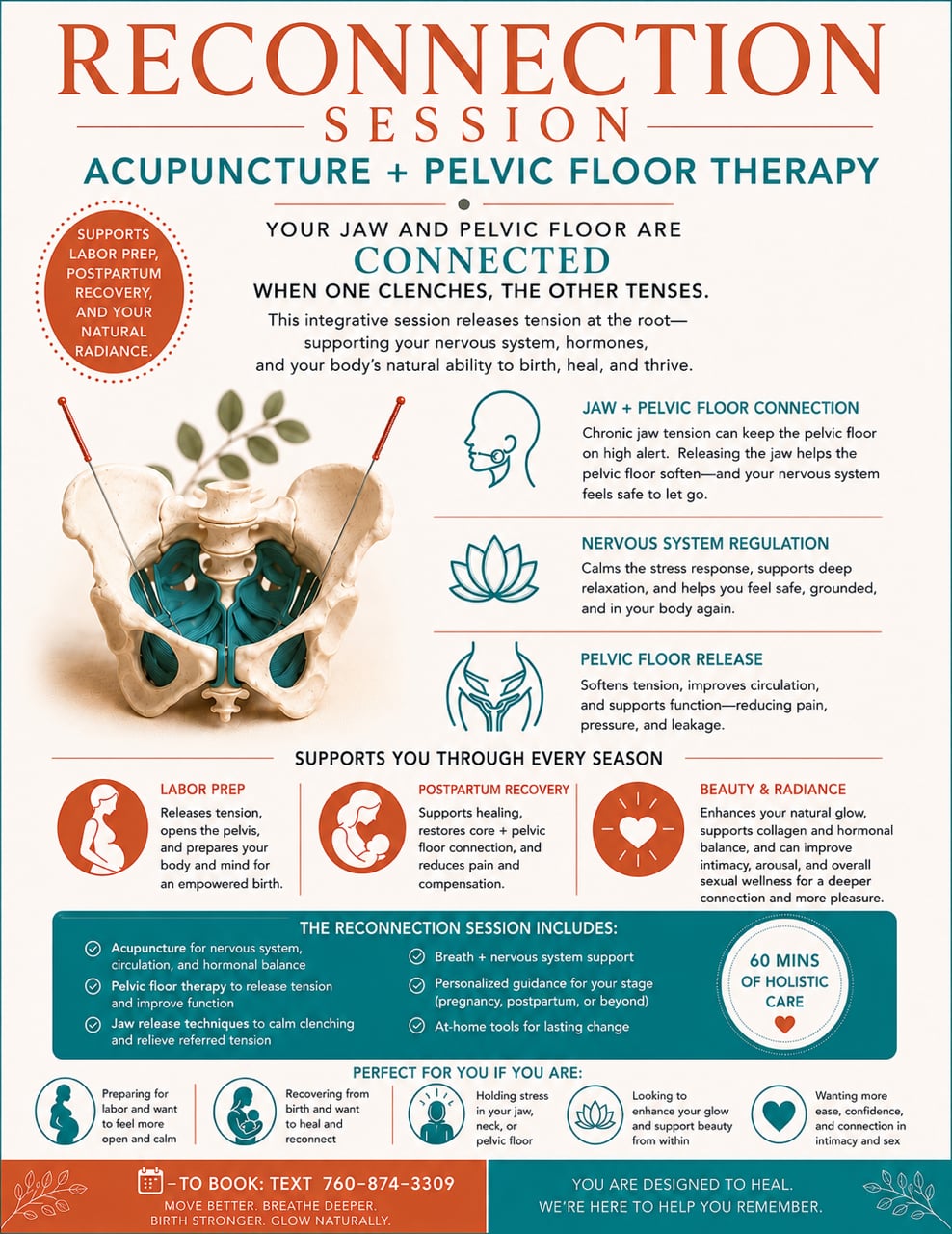
If you want to share the Reconnection Session with someone, this is the printed flyer we hand out at the clinic.
Selected references
- Bordoni B, Zanier E. Anatomic connections of the diaphragm: influence of respiration on the body system. Journal of Multidisciplinary Healthcare. 2013;6:281-291.
- Chae Y, Chang DS, Lee SH, et al. Inserting needles into the body: a meta-analysis of brain activity associated with acupuncture needle stimulation. The Journal of Pain. 2013;14(3):215-222.
- FitzGerald MP, Anderson RU, Potts J, et al. Randomized multicenter feasibility trial of myofascial physical therapy for the treatment of urological chronic pelvic pain syndromes. The Journal of Urology. 2013;189(1 Suppl):S75-S85.
Ready to book?
Text me and we will get you on the calendar for a Reconnection Session with Nina and me.